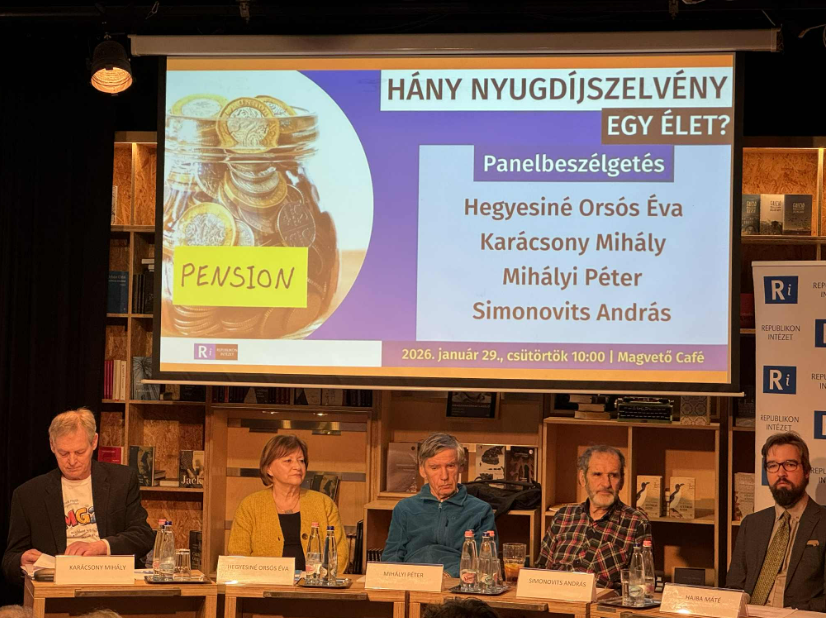
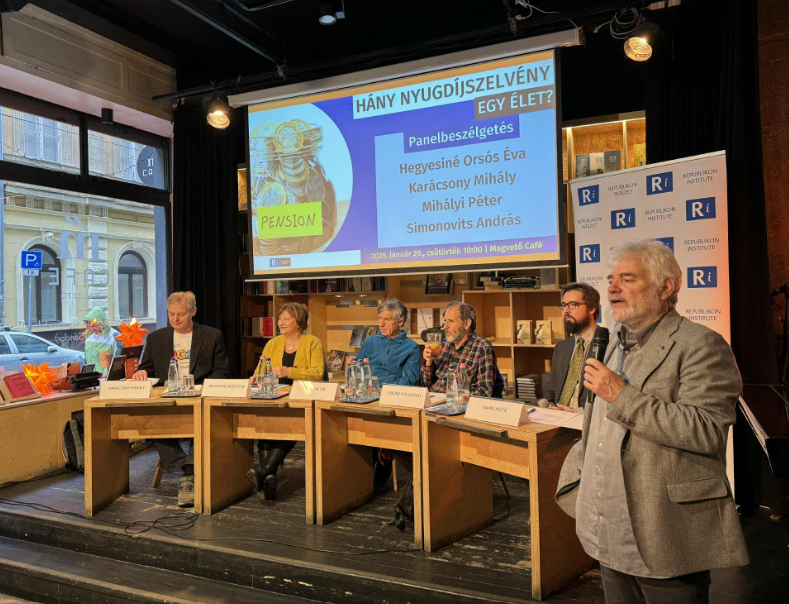
On January 29, 2026, the Republikon Institute held a conference entitled "How many pension slips make a lifetime? – Age politics before the elections" where experts examined issues within the Hungarian pension system, such as the flaws of the system, the retirement age, the 13th and 14th month pensions, and the issue of loneliness.
The discussion was moderated by Máté Hajba, senior analyst at Republikon.
Following the opening remarks by Gábor Horn, the director of the Republikon Institute, Márton Schlanger, a researcher at the institute, presented important statistics regarding age politics in Hungary. Schlanger revealed that Hungary spends approximately 7% of its GDP on pension expenditures, which is significantly lower than the EU average of around 12%. As a result, nearly half of Hungary's approximately two million pensioners live on less than 200,000 forints per month, with around 800,000 of them falling below the subsistence level. The relative value of pensions has also deteriorated considerably over the years. In 2010, the average pension was 65% of the average wage; however, by 2025, this ratio is expected to drop to around 50%. This decline occurs within a demographic and social context where the increasing demand for benefits must be funded by a shrinking pool of active workers. The challenges facing the pension system are further complicated by health and social issues. According to Eurostat data, four out of ten Hungarian men do not live to reach retirement age. Additionally, the World Health Organization estimates that 25-30% of older adults live in social isolation, leading to feelings of loneliness. Beyond its implications for welfare, this situation also carries political significance, as voter turnout is typically highest among the elderly. In this context, Schlanger also addressed assisted voting methods, pointing out that solutions such as mobile ballot boxes have limited verifiability. Another politically significant factor is that since the ban on political advertising on social media, hidden political content and fake news generated by artificial intelligence have been spreading rapidly, and recognizing them often requires advanced digital skills, which in many cases are not available to the retired generation. Finally, following the presentation of the above data, Márton Schlanger shared with the audience the results of a study conducted by the Republikon Institute. In the survey, retirees were asked about raising the retirement age, their preferences for pension increases adjusted for inflation or wage increases, and their opinions on the 14th-month pension. The researchers also compared the results according to the political affiliation of the respondents.
This was followed by a panel discussion focusing on the problems of the pension system, current solutions to the pension system, loneliness, and the retirement age. The participants in the discussion were Éva Hegyesiné Orsós, social policy expert and president of the Nyugdíjas Klubok és Idősek „Életet az éveknek” Országos Szövetség; Mihály Karácsony, president of the Országos Nyugdíjas Parlament; Péter Mihályi, economist, university professor, corresponding member of MTA; and András Simonovits, mathematician, economist, and retired university professor.
Mihály Karácsony was one of the first to speak during the discussion. He expressed his belief that the sustainability of the pension system should primarily be seen as an economic and productivity issue rather than a demographic one. In his opinion, Hungary allocates insufficient capital from its gross domestic product to finance old-age benefits. He noted that the total pension contributions made by active workers and their employers exceed the amount the budget provides in the form of public benefits. Karácsony argued that pension distribution should be based on earnings-related indexation that operates independently of the budget. This approach would mean that the value of pensions would be tied to current wage trends, allowing pensions to increase in line with the earnings of active workers and preserving previous income ratios. He emphasized that this method would differ from the current inflation-linked pension distribution. In this context, he viewed the concept of a 13th-month pension as debatable, suggesting that it should be considered a separate benefit rather than an integral part of the system. Additionally, Karácsony made a specific proposal to improve the current pension system: he called for greater transparency by establishing a Pensioners' Chamber and facilitating clearer communication. In terms of political promises and current solutions, he welcomes Tisza's proposals to increase the capacity of retirement homes and raise home care fees by 50 percent. He also supports the Széchenyi Card Program, which is currently in operation, as the card format ensures that benefits are used for domestic consumption.
According to Éva Hegyesiné Orsós, a significant flaw in public discourse about retirees is the tendency for excessive generalization. Not all elderly individuals rely solely on their pensions, and their life situations can vary greatly. A central aspect of her perspective is the mission of the "Életet az éveknek" Országos Szövetség, which aims to promote active and high-quality retirement. She argues that the social conditions necessary to achieve this are currently lacking. She views isolation and loneliness as serious issues that are often overlooked in political promises. While political programs typically address matters such as pension trends, social security, and health issues, they rarely tackle the structural causes of loneliness. For example, opportunities for organized education and training generally cease to exist after a certain age. She also believes that digital exclusion contributes to feelings of loneliness, as many older people lack the skills needed for modern administrative tasks, which can lead to feelings of humiliation. Currently, there is no policy solution to address this issue, even though many pensioners could adapt with appropriate support. She argues that raising the retirement age is not considered justified. Instead, a flexible retirement system should be established, along with a well-thought-out time policy. This policy should recognize that some individuals can continue working during their retirement years, while others may struggle with health issues even before reaching retirement age. Additionally, the circumstances of low-income pensioners should be analyzed and improved separately. There is also a strong need for a comprehensive analysis of the workforce by experts.
Péter Mihályi addressed the issues within the Hungarian pension system from both a historical and structural perspective. He examined the aspects of the system's functionality that had been lost over the past decades. Mihályi emphasized the need for a "paradigm shift," which he clarified would not involve introducing new benefits but rather rethinking the logic underlying financing and indexation. He advocated for a return to Swiss mixed indexation— a pension distribution system that factors in both wages and inflation. While this approach may raise pensions more gradually, it offers better protection for their real value over time. Mihályi argued that this change is necessary because society has, in the past, accepted the renationalization of the private pension fund pillar with minimal resistance. This acceptance has, in the long run, constrained the system’s adaptability and created structural issues that he believes can only be resolved with more radical solutions. One example he provided was the elimination of the 13th and 14th month pensions. Although these payments can be beneficial to individuals, they are ultimately unsustainable for the overall system due to the additional financial resources they require. Additionally, Mihályi raised concerns about isolation among pensioners, warning them to be cautious of unrealistic promises. He pointed out that certain living conditions—such as the effects of hard physical labor or differences in life expectancy between genders—cannot be "erased" through policy changes, even though they significantly impact quality of life in old age.
András Simonovits provided an analysis of pension system reform, focusing on both technical and political realities. He believes that returning to mixed indexation is a viable option, but he would essentially maintain the 13th and 14th month pensions, as he thinks these payments enhance the real value of established benefits by approximately 2 percent. While he views this as beneficial in the short term, he also recognizes the potential long-term negative consequences of this approach. He points out that the 14th-month pension automatically increases both newly established and existing amounts, which presents a flaw in the system. Simonovits proposes that the long-term solution would involve gradually phasing out these extra benefits for new pensioners. This could be achieved by slowly increasing the requirement for women to qualify for early retirement from 40 years of service. He also stressed that the state’s budget deficit of around 5 percent significantly limits its capacity to make changes. Additionally, he warned that the increasing disparity in pensions could lead to a distorted and unfair distribution in the long term. Given these considerations, Simonovits does not anticipate any major changes while the current ruling party remains in power. However, he believes that a government led by Tisza would be more likely to introduce new initiatives and pension increases that could enhance the system's functionality over time.
Following the panel discussion, the audience had the opportunity to ask questions to the panel.
The operation of Republikon Institute is supported by the European Union. The views and opinions expressed at the event do not necessarily reflect that of the European Union. Neither the European Union, nor the organisation providing support can be made responsible for these.