
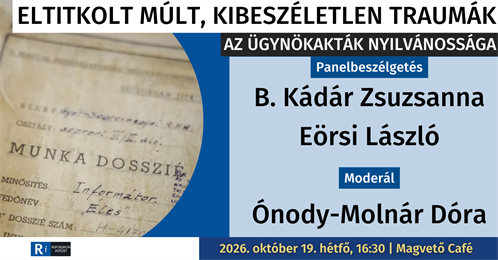
On October 29, the Republikon Institute held a panel discussion at Magvető titled “Concealed Past, Unspoken Traumas: The Publicity of the Agent Files.”
Opening remarks: Gábor Horn (Chairman of the Board, Republikon Institute): Who would have thought that in our lifetime we could talk about what was actually in these files, and that they would really be made public? What will happen on November 4? Will we be able to handle this information?
Expert panel
Zsuzsanna B. Kádár (historian and historical sociologist): The release happens in two phases, and one of them has been postponed to November 4. That phase covers those who were recruited, and it will be available on the state security archive website. The second phase is expected next year: the recruitment files, the so-called B-files, are expected on February 25. There is no such thing as a complete list of agents. This data has to be handled properly. People need to be taught that when this information comes out, it must be viewed in the context of its time, along with the reasons people had and how long they served as network persons, that is, agents. Publishing the lists will not bring social catharsis. At most it may mean a harder period within families. We can be quite skeptical about the files in their entirety, since much of the data is not original and not complete; material has been removed from them (János Kenedi).
An agent is fundamentally a victim. The villainy should be sought on the other side, in the handlers, the party secretaries, and the general secretaries. For processing the data and forming a moral judgment, it is best to turn first of all to the archive’s staff and to understand it with their help. What matters is always the story, the context: you see a name, and a name alone cannot be interpreted. That is why the two-phase release is unfortunate. Its effect will be a story of lived experience within families, and most likely it will not be about prominent individuals who attract media attention.
László Eörsi (historian, researcher at the 1956 Institute Foundation): It depends on how much information will be researchable, that is, how much material the individual secret services handed over to the Historical Archives of the State Security Services. After 30 years, classified material has to be declassified. Even now, though, there will be data we cannot access, and the greatest puzzle is how the various services can still have so much material in their own hands. There will also be important material on how the system worked, and the information will mostly date from the late 1980s. Of 150,000 items, only 50 to 60 thousand will be available, so only a part of the history can be researched, but even that is worthwhile. This data is also interesting because it may help us figure out why Fidesz wanted to prevent its release.
First, only the names will come out, and then on February 25 we can expect the data to be refined, covering the circumstances of the recruitments. Because the information is not coming out all at once, we can expect four months of speculation. We should not expect great chaos, since in the past 36 years there has never been any great catharsis when data came out, even about popular figures. The data on important people was probably “cherry-picked” by those with an interest in doing so and access until now. Politically significant figures probably will no longer be in it. This information may not have been made public until now because it went against the political interests of whoever was in power.
Moderator: Dóra Ónody-Molnár
The struggle to open the files has been a 36-year project. The Tisza government is now paying off the previous regime's debt. What is the significance of the release actually taking place?
The event can be watched at the link below:
https://www.youtube.com/watch?v=tNjqFjk0BXc&t=7s