I. panel
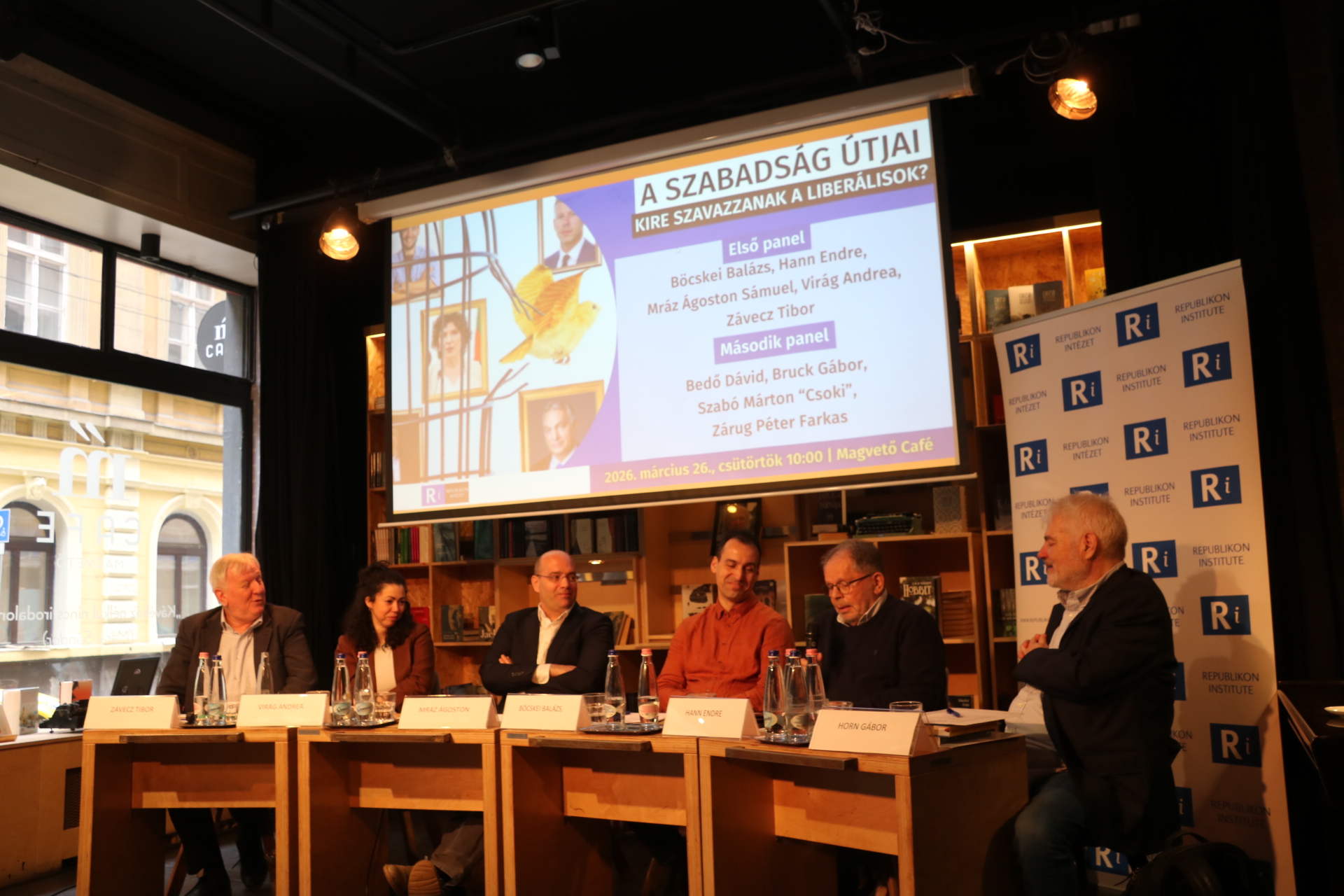
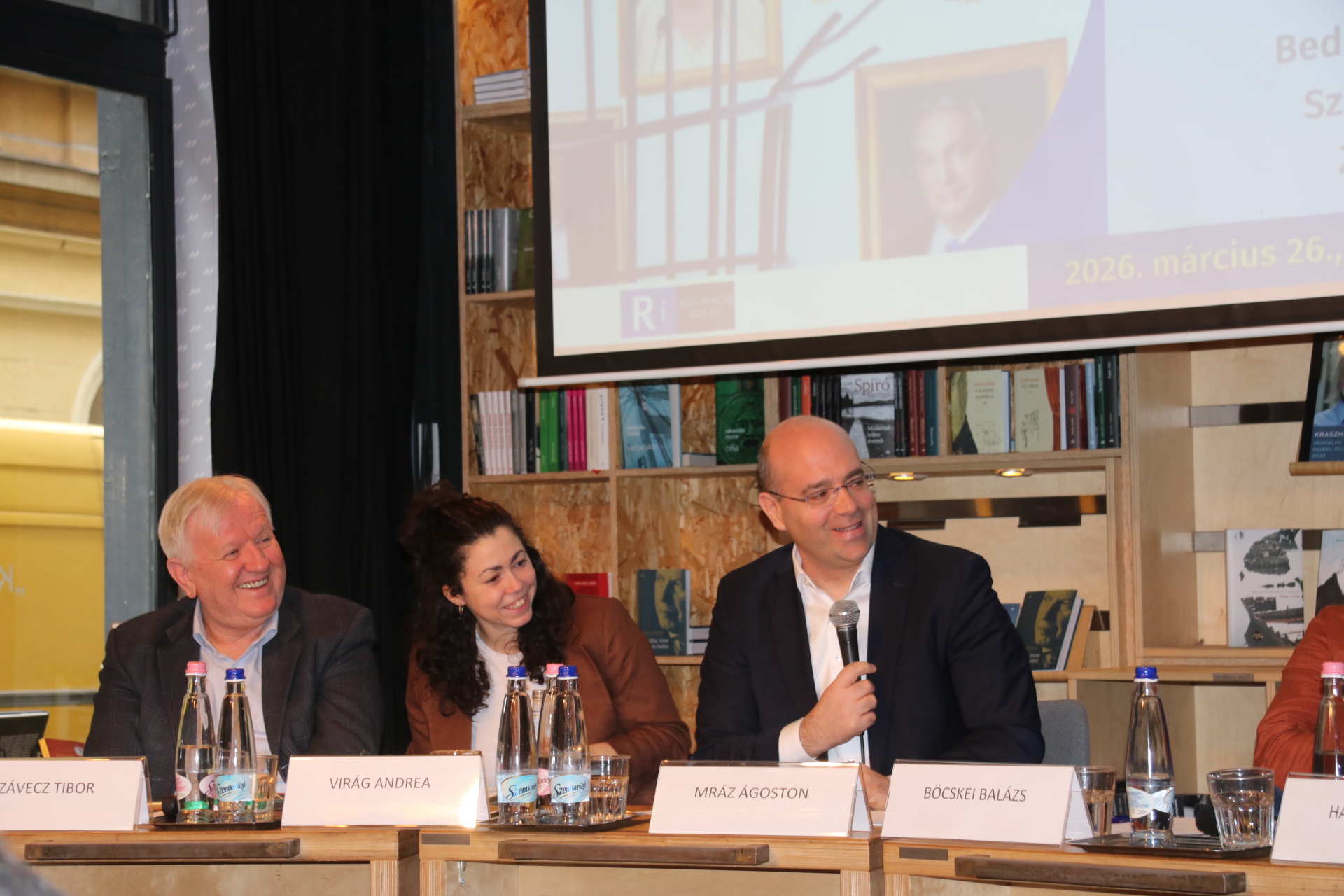
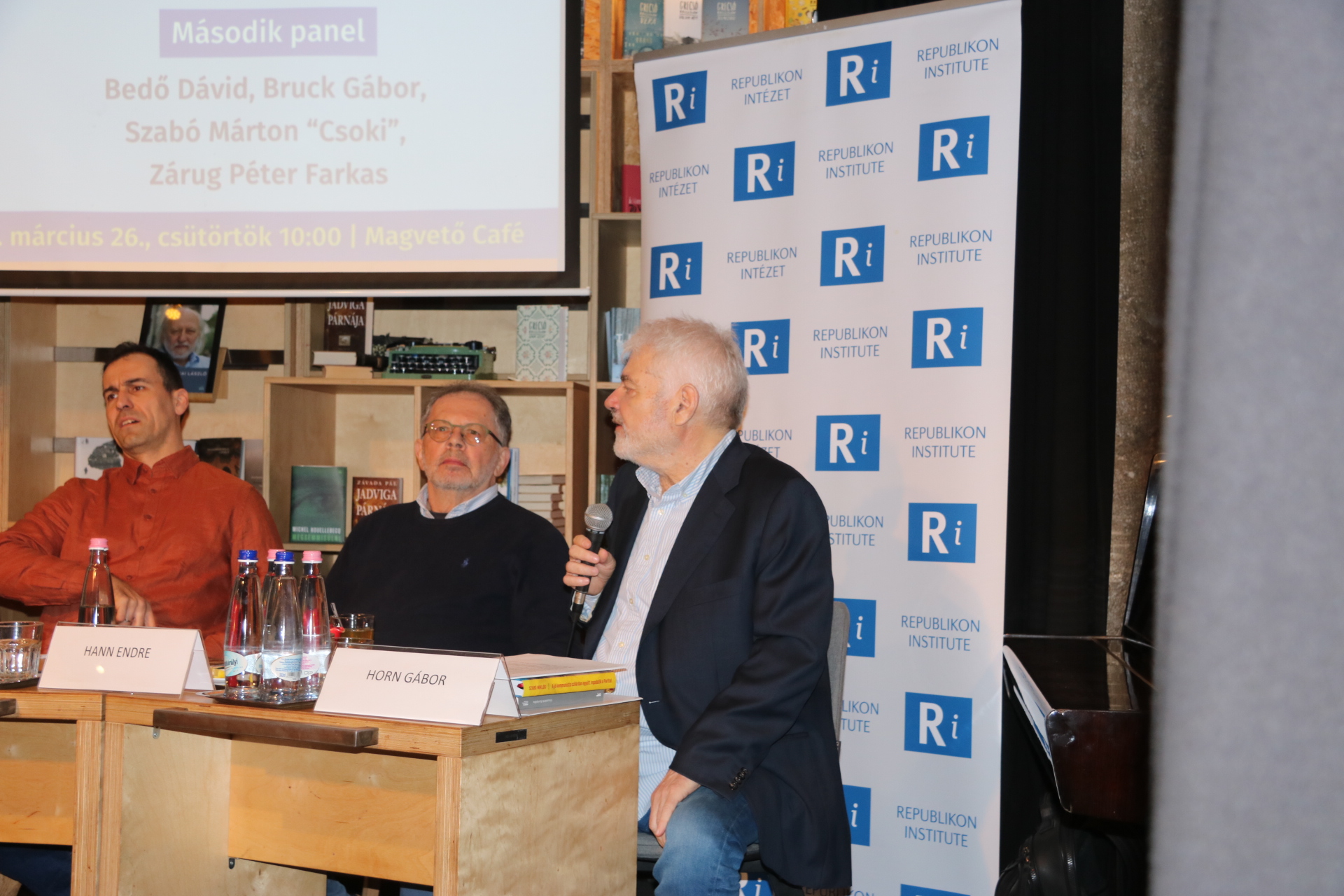
The first panel examined the balance of power in the election, the dynamics of the campaign, and differing interpretations of the polls. The panelists were Balázs Böcskei (IDEA Institute), Endre Hann (Medián), Ágoston Sámuel Mráz (Nézőpont Institute), Andrea Virág (Republikon Institute), and Tibor Závecz (Závecz Research). The discussion was moderated by Gábor Horn, the head of Republikon Institute. The participants agreed that the political race is organized around two major blocs, while the growing willingness to participate primarily limits the maneuvering room of smaller parties; the DK and the MKKP will almost certainly fail to enter parliament, and although this trend does not favor Mi Hazánk either, they remain above 5%.
Tibor Závecz emphasized that Tisza and Fidesz have the largest base of supporters—with at least 3 million Tisza and 2.5 million Fidesz voters, according to his estimates—and no significant strategic shifts are expected during the campaign. He noted that if anyone were to stray from the well-trodden path, it would undermine the appearance of confidence, while the two leaders dictate the narrative with their daily speeches. Péter Magyar must reinforce the image of the alternative, and although close results are expected in several single-member districts (as many as 10–30 districts) where the parties will have to give it their all, it is not yet clear where the election will be decided geographically.
Andrea Virág pointed out that, according to her data, Tisza leads by 5% among the general population and by 8% among likely voters. In her view, the gap between the two major parties has not changed significantly over the past year and a half, while both have managed to expand their support bases at the expense of undecided voters. The main campaign themes (war and peace) have solidified, but issues related to intelligence services and wiretapping have emerged as new elements, though it remains to be seen how long their impact will last. He specifically highlighted the situation of Mi Hazánk: Fidesz is sending mixed messages regarding its relationship with the party, and since their role as “kingmakers” has come to the fore, it may now be in Fidesz’s interest to reach out to their voter base—something it did not need to do in 2022.
Based on his own weekly data, Ágoston Mráz projected a Fidesz lead (40% vs. 35%), which translates to approximately 3 million Fidesz supporters and 2.7 million Mi Hazánk supporters. He described the campaign primarily as a mobilization contest, in which Mi Hazánk supporters are currently more active. In his view, Fidesz’s goal is to capitalize on the overlap between Mi Hazánk voters and inactive voters, as well as to get Mi Hazánk into parliament. He observes that activity decreases as one moves away from Budapest, but overall he expects a Fidesz victory and considers it important to compile demographic statistics later on.
According to Balázs Böcskei, the majority of analysts—four out of five researchers—do not see a truly close race; the outcome of this election has been decided for quite some time, and with a 12% lead, a turnaround is not expected. He emphasized that the campaign issues have been set in stone since the summer of 2025; what is happening now is more a matter of delving deeper into them and reframing them. He noted that trust in polls is low, which they have measured but not published in order to preserve the profession’s legitimacy. Regarding Mi Hazánk, he said that although they are speaking less, they are effectively building their subculture and video reach, and since voters are strategic, no “lost” districts are expected due to small parties.
Citing Medián’s research, Endre Hann predicted a strong lead for Tisza (3.5 million vs. 2.5 million) and record-high turnout, which could even result in a two-party parliament, as he views Mi Hazánk’s entry into parliament as uncertain. He emphasized that voter perceptions have been predicting a Tisza victory since March. He attached great importance to intelligence service issues and Péter Magyar’s video outreach. He stressed that his data are snapshots, not predictions, and rejected the accusation of “cowardice,” recalling Medián’s independence and accuracy since 1989.
At the end of the discussion, a heated methodological debate ensued. Endre Hann criticized the lack of independence of pro-government institutes and, in his view, Ágoston Mráz’s propagandistic behavior, as well as the smear campaigns against Medián. In his response, Ágoston Mráz defended Nézőpont’s “realistic” methodology, which uses statistical procedures to classify voters who are certain to vote but are not affiliated with any party. The accuracy of Medián’s sampling (particularly among young people) and the conditions of telephone data collection in connection with the collaboration with the Iránytű Institute also became topics of debate. In response, Hann stated that they work with multiple call centers and views the methodological criticisms as an attack on independent research.
II. panel
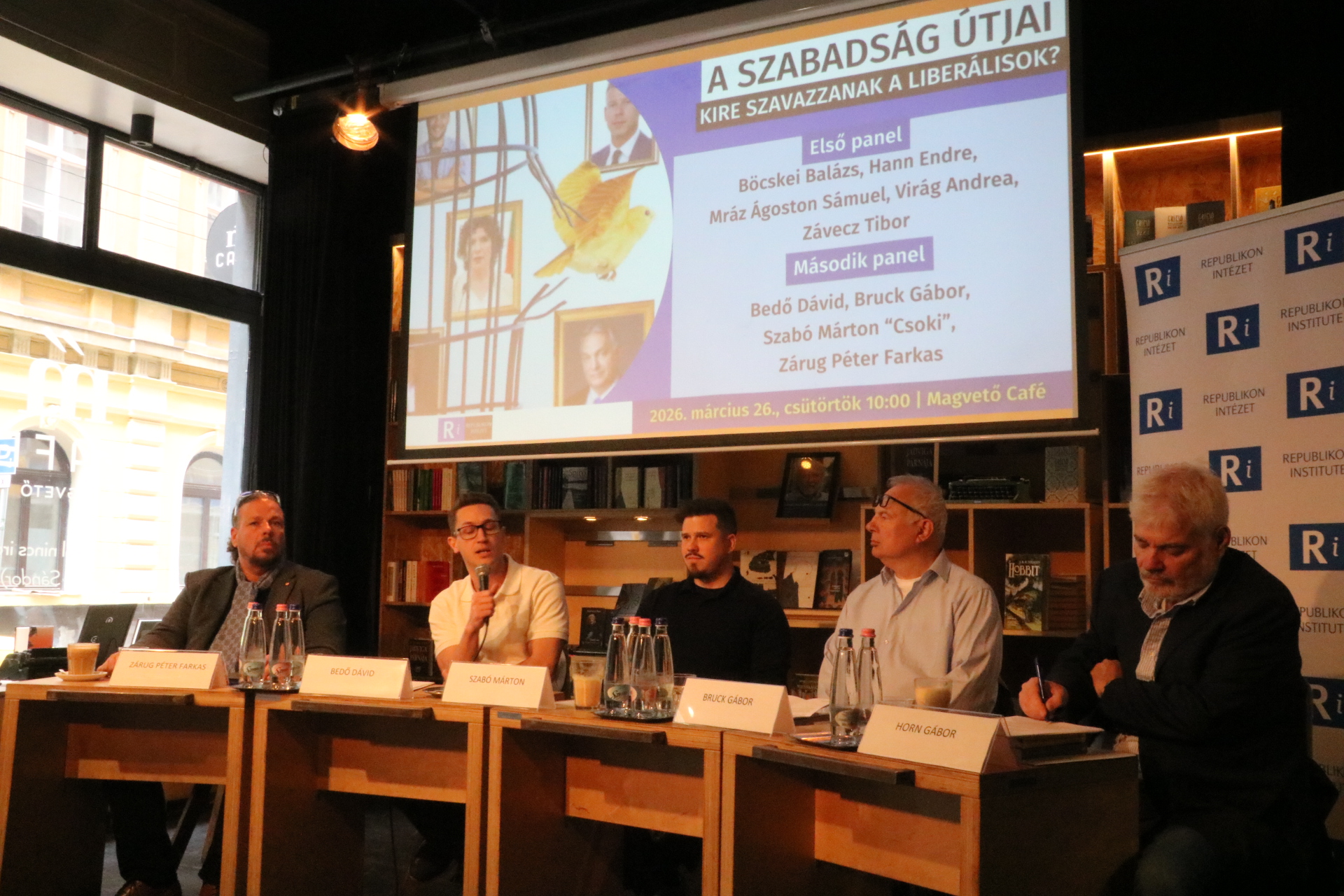
In the second panel, Dávid Bedő, leader of the Momentum parliamentary group; Gábor Bruck, communications trainer at the Sawyer Miller Group; Márton “Csoki” Szabó, content creator; and Péter Farkas Zárug, political scientist and associate professor at the University of Miskolc, discussed liberalism in Hungary. The panel discussion explored whether there are liberal voters, the state of their representation, and who they should vote for on the 12th of April.
According to Gábor Bruck, liberalism as an idea cannot be lost as long as there is a concentration of power. He sees these principles reflected in TISZA as well, since the party strives to open up the political arena and create the conditions for competition. That said, he does not view liberalism as an identity, nor is it necessarily practical to understand it that way: rather, it is a set of rules that can be embraced by multiple ideological projects. He considers Péter Magyar’s political approach innovative in many respects and expects the old opposition parties to disappear entirely. To bring about change, he believes voting for TISZA is the right move, and he can be optimistic only if the TISZA szigets remain active even after a potential victory, so that decisions aren’t made top-down from Budapest.
Márton “Csoki” Szabó stated that there is clearly a demand in Hungarian society for liberal and left-wing ideas. He believes that for successful political representation, it is important for parties not to view people merely as voting machines, but to involve them as much as possible in political processes. This requires parties that authentically represent liberal and left-wing ideas, not just factions that happen to include people with left-wing leanings. This side has not yet found a counterproposal to the populist right, but he believes it is taking shape, and he argued that the role of ideologies may gain importance in the future, even if it is fashionable today to proclaim ideological neutrality. He identified solidarity as the antidote to ideologies seeking to dismantle liberal democracy. He sees the essence of liberalism as people being able to decide for themselves who to vote for, and he emphasized that it is essential to go out and protest on important issues regardless of who wins the election.
Dávid Bedő stated that there are many liberals in Hungary: both economically and culturally. However, this election is not about ideologies, which is why there will be no liberal party in parliament. TISZA also has liberal politicians and voters, and the priority is to use TISZA to replace the system; only then is there room for value-based politics. He identified electoral reform as a top priority: the two-party system leads to populism and prevents pluralistic representation. He stated that he has doubts about how much Péter Magyar and his allies will limit their own power, but he believes it will also be the task of liberal voters to force the restoration of a pluralistic system. In his view, propaganda has greatly damaged the reputation of liberalism, but he also noted that European liberals have, in many cases, failed to properly recognize the needs of the majority or have failed to provide adequate responses, such as in the case of the refugee crisis. Bedő emphasized that Fidesz can now only win through fraud, and he is pinning his hopes on TISZA’s constitutional majority to ensure accountability.
According to Péter Farkas Zárug, there are liberal voters in Hungary, but the issue is their representation. In the current post-ideological climate, these voters do not form a community, and they perceive the mission proclaimed by TISZA as stronger than what liberal forces represent domestically. There is no unifying force for liberalism in Hungary; liberalism appears only in a performative manner around specific issues, a good example of which is Pride. He stated that Fidesz has successfully monopolized the interpretive frameworks of public discourse, and this has frightened both liberal politicians and voters. He called it the paradox of liberalism: the foundation of a liberal system is the value system of citizens, but the state cannot regulate this. Hungary has never been liberal in spirit, but rather feudal, and there is insufficient civic development to create the material and cultural foundations for broad-based liberalism. In his view, within a democratic framework, TISZA—and likely Mihazánk as well—will gain entry. In the event of a Fidesz victory, he sees a strengthening of authoritarian tendencies as likely. With a simple majority, TISZA “will be in government but not in power,” and in the case of a constitutional majority, he believes the state will undergo restructuring, but they will not limit their own power.